Prostate Ultrasound and Biopsy
During a biopsy of the prostate, the urologist obtains a piece of prostate tissue for analysis to confirm or exclude cancer in the prostate.
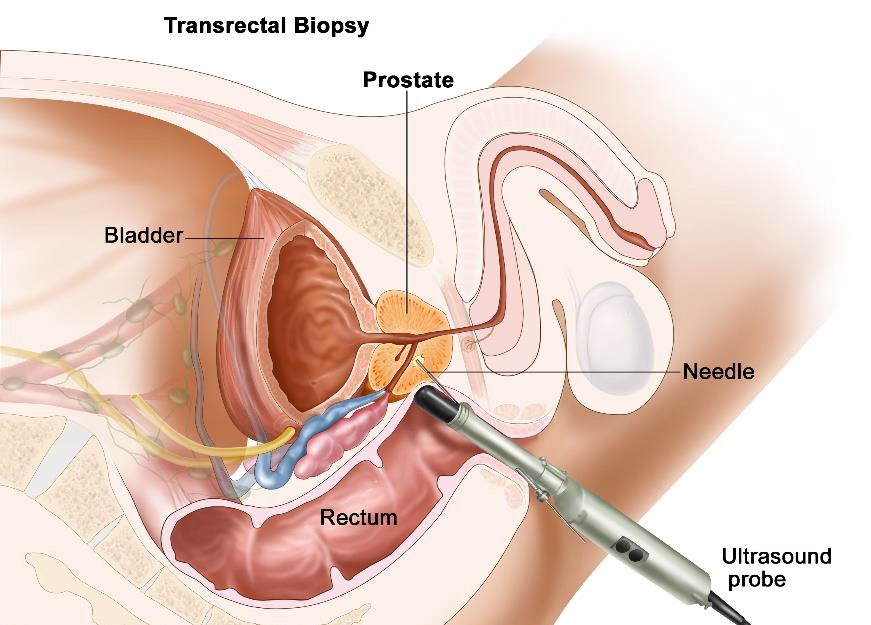
A biopsy needle is pushed into the prostate and cut a small piece of prostate tissue out. The biopsy can be done through the rectum or through the skin just above your anus.
Why is a prostate biopsy done?
A prostate biopsy will be done if there is any suspicion of prostate cancer. Your urologist will suggest a prostate biopsy if you have a raised PSA blood test or if the urologist feels an abnormality in your prostate.
Diagram
What are the alternatives to this procedure?
Alternatives to this procedure include observation with repeat blood tests but without biopsies.
What should I expect before the procedure?
Prostatic ultrasound is usually performed under general anaesthetic. You will normally be admitted to hospital on the same day as the procedure. Once you have been admitted, you will be seen by the anaesthetist.
If you are taking warfarin, you must inform the doctor and anaesthetist and you are advised to stop it before the procedure. A blood test (INR) will be performed prior to your biopsy. If you are taking aspirin, you do not need to stop this but, if you are taking clopidogrel or any of the other blood-thinning drugs mentioned below, you must inform the doctor because the biopsy may need to be postponed or alternative arrangements made. After checking for allergies, you will normally be given an antibiotic tablet or injection to prevent infection in the prostate, urine, or bloodstream.
Please tell your surgeon and anaesthetist [before your surgery) if you have any of the following:
- An artificial heart valve.
- A coronary artery stent.
- A heart pacemaker or defibrillator
- An artificial joint
- An artificial blood-vessel graft
- A neurosurgical shunt
- Any other implanted foreign body
- A regular prescription for a blood-thinning agent such as warfarin, aspirin, clopidogrel (Plavix®], rivaroxaban, or dabigatran
What happens during the procedure?
You will go to the theatre where the anaesthetist will give you general anaesthesia or regional anaesthesia in the form of a spinal injection that will take all the sensation away in your lower body. You will be given antibiotics in theatre to prevent infection.
The doctor will first do a cystoscopy to examine your bladder and the inside of your prostate. After that, the doctor will examine the prostate through the back passage (rectum) before inserting the ultrasound probe. This probe is as wide as a man’s thumb and approximately 10cm long.
Taking the biopsies involves passing a needle through the centre of the ultrasound probe. The biopsy ‘gun’ is activated by a spring-loaded device and makes an audible “crack”. We normally take 16 – 24 biopsies of the prostate.
What happens immediately after the procedure?
You might experience a sensation of wanting to go to the loo frequently. It might feel like you have difficulty passing urine, which will subside after a short while.
Blood in the urine is common for 2 to 3 days after the biopsy. Increasing your fluid intake usually stops this bleeding. Bleeding may also occur from the back passage (rectum). You might see blood in the semen – it can last for up to six weeks.
You will be given antibiotics to take home for a three-day period.
If you can pass urine without too much discomfort, you can go home. You will not be able to drive yourself home after general anaesthesia. The average hospital stay is less than one day.
What are the side effects of a prostate biopsy?
Most procedures have possible side-effects. But, although the complications listed below are well-recognised, most patients do not suffer any problems.
Common
- Blood in your urine.
- Blood in your semen for up to 6 weeks after the biopsy. You do not have to worry about this, it is not dangerous for you or your partner.
- Blood in your stools.
- Urinary infection (10% risk).
- Discomfort from the prostate due to bruising.
- Bleeding in the bladder with clot formation and inability to pass urine.
Occasional
- Severe infection (septicemia) needing admission to hospital (2% risk).
- Bleeding needing admission (1% risk).
Rare (less than 1 in 30)
- Inability to pass urine (retention of urine).
- Hospital-acquired infection.
Please note: It can happen that prostate cancer is missed with a prostate biopsy or prostate cancer can only start developing after you had a prostate biopsy. For that reason, you must follow up with your urologist at least once a year. Continue to do blood tests (PSA) and prostate examinations even if your prostate biopsy is negative.
What should I expect when I get home?
WIt is normal if you experience some discomfort at the rectum. Use the pain medication prescribed by your urologist if you feel it is necessary.
You might get antibiotics to finish at home.
Take it easy for 1 to 2 days, avoid any strenuous exercise or physical activity.
Drink a lot of fluids.
Take care that you do not develop constipation. Adjust your diet or take some laxatives if you are prone to develop constipation.
Red or rust-coloured semen is normal after the biopsy. It might persist for up to six weeks
What else should I look out for?
A fever or shivering requires urgent action, and your doctor should be informed immediately. If you develop a fever outside surgery opening hours, you must go to the Emergency department immediately so that a doctor can assess you. They will phone your urologist if it is necessary. If you get a lot of bleeding in the urine or from the back passage, especially with clots of blood, you should also visit the Emergency Department at the hospital.
My biopsy results
You will have to phone the consulting rooms to book an appointment for a discussion of the biopsy results. It normally takes about 5 to 7 days so it will be safest to book the consultation the week after the biopsy. At this appointment, you will get information about further treatment or tests that might be necessary.
Driving after surgery
You are not allowed to drive yourself after you had anaesthesia. Please ask somebody to pick you up from the hospital.
Phone us if any of the following occurs
A fever or shivering requires urgent action and your doctor should be informed immediately. If you develop a fever outside surgery opening hours, you must go to the Emergency department immediately so that a doctor can assess you. If you get a lot of bleeding in the urine or from the back passage, especially with clots of blood, you should also visit the Emergency Department at the hospital.